RU
RU  ES
ES  FR
FR  EN
EN  IT
IT 
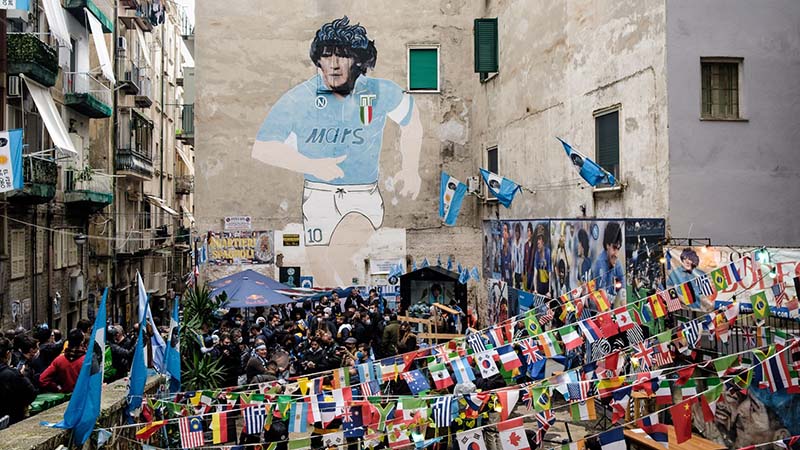
Maradona’s mural in the Quartieri Spagnoli is one of the most visited attractions in Naples and one of the city's symbolic landmarks. It is located in Via Emanuele De Deo, in the heart of the Quartieri Spagnoli, just a few minutes' walk from Hotel Il Convento.
Visiting this place means discovering much more than a piece of street art: the mural tells the story of the deep bond between Naples, Diego Armando Maradona, football, popular identity, and the recent history of the city.
Where is the Maradona mural located in Naples?
The Maradona mural is located in the Quartieri Spagnoli, in Via Emanuele De Deo, in the area known today as Largo Maradona. The area is in the center of Naples, a short distance from Via Toledo, one of the city's most famous and busiest streets.
In recent years, the mural has become a must-see stop for anyone visiting Naples. It is not just a place to take a photograph, but a living space, crossed every day by residents, tourists, football fans, and the curious.
Here, you can breathe in the authentic spirit of Naples: narrow alleys, small shops, cafés, laundry hanging to dry, votive shrines, voices, scooters, and colors that tell the story of the neighborhood's daily life.
How to reach the Maradona mural from Hotel Il Convento?
The Maradona mural can be reached on foot from Hotel Il Convento in just a few minutes. The route is simple: upon leaving the hotel, turn left and enter the third street on the left, Via Emanuele De Deo. Continuing to the end of the street, you will arrive at the famous mural.
The walk is short, but it is worth taking your time. The Spanish Quarters are part of the experience: even before arriving in front of Maradona's face, you enter the most popular and recognizable heart of Naples.
For those staying in the center, this is one of the easiest visits to organize: no public transport, tickets, or reservations are needed.
When is the best time to visit the Maradona mural?
The Maradona mural in the Spanish Quarters is outdoors and can be visited every day, free of charge and without any entry times.
The best time to visit is in the morning, especially on weekdays. During these hours, the area is generally less crowded, making it easier to stop, observe the mural, and take some photographs.
Afternoons, weekends, and peak tourist seasons are much busier. There are more people, but also more energy: for those who want to experience the lively atmosphere of the Spanish Quarters, this can be the right time.
Brief history of the Maradona mural in the Spanish Quarters.
The Maradona mural was created in 1990 by Mario Filardi, following Napoli's second championship title. It was not born as a tourist attraction, but as a spontaneous and popular gesture, created in the neighborhood to celebrate Diego Armando Maradona.
For Naples, Maradona was not just a great footballer. He was a symbol of redemption, pride, and belonging. With him, Napoli won and the city felt like a protagonist, at the center of the world.
Today, there are more recent and realistic Maradona murals in Naples, but the one in the Spanish Quarters remains the most important. It was the first, and it is the one that preserves the most direct bond between Diego, Napoli, and the city.
Other Maradona murals in Naples.
In addition to the mural in the Spanish Quarters, there are other tributes dedicated to Diego Armando Maradona in Naples. The most well-known is the large mural created by Jorit in San Giovanni a Teduccio, on Via Taverna del Ferro.
Jorit's mural is modern, monumental, and realistic. The one in the Spanish Quarters, on the other hand, has a more historical and popular value. It is less perfect from an artistic point of view, but perhaps for this very reason, it is even more moving.
Visiting both allows you to see two different sides of the same myth: the Maradona born from the popular heart of the Spanish Quarters and the Maradona told through great contemporary street art.
PReasons to visit the Maradona mural.
The Maradona mural in Naples has over time become a sort of secular sanctuary. Around Diego's face, one can find flags, scarves, jerseys, photographs, dedications, and small objects left by visitors.
People arrive from all over the world: Argentine fans, football enthusiasts, curious travelers, and tourists who might not follow the league but know that in Naples, Maradona is something more.
The mural also tells the story of the transformation of the Spanish Quarters: a working-class area, today increasingly visited by international tourism, but still deeply linked to its own identity.
Visiting the mural while staying in the center of Naples.
For those staying at Hotel Il Convento, visiting the Maradona mural in the Spanish Quarters is one of the most immediate experiences to have in Naples. It only takes a few minutes on foot to reach one of the most photographed and significant places in the city.
It is an ideal stop to include in a walk between Via Toledo, the Spanish Quarters, Piazza del Plebiscito, the Galleria Umberto I, and the historic center.
The mural does not just speak of football. It speaks of Naples, its popular memory, its pride, and its unique way of transforming a wall into an international symbol.
Frequently asked questions about the Maradona mural in the Spanish Quarters.
Where is the Maradona mural in Naples located?
The Maradona mural is located in the Spanish Quarters, on Via Emanuele De Deo, in the square known as "Largo Maradona," near Via Toledo.
How far is the Maradona mural from Hotel Il Convento?
The mural can be reached from Hotel Il Convento on foot in just a few minutes. It is one of the closest attractions to the hotel and does not require the use of public transport.
Is the Maradona mural free to visit?
Yes, the mural is outdoors and can be visited for free every day, without the need for tickets or specific entry times.
When is the best time to visit the Maradona mural?
The best time to visit is in the morning on weekdays, when the area is less crowded. Afternoons and weekends are busier, but offer a more vibrant and energetic atmosphere.
What is there to see near the Maradona mural?
In the surrounding area, you can visit Via Toledo, Galleria Umberto I, Piazza del Plebiscito, the San Carlo Theater, and the historic center of Naples.